
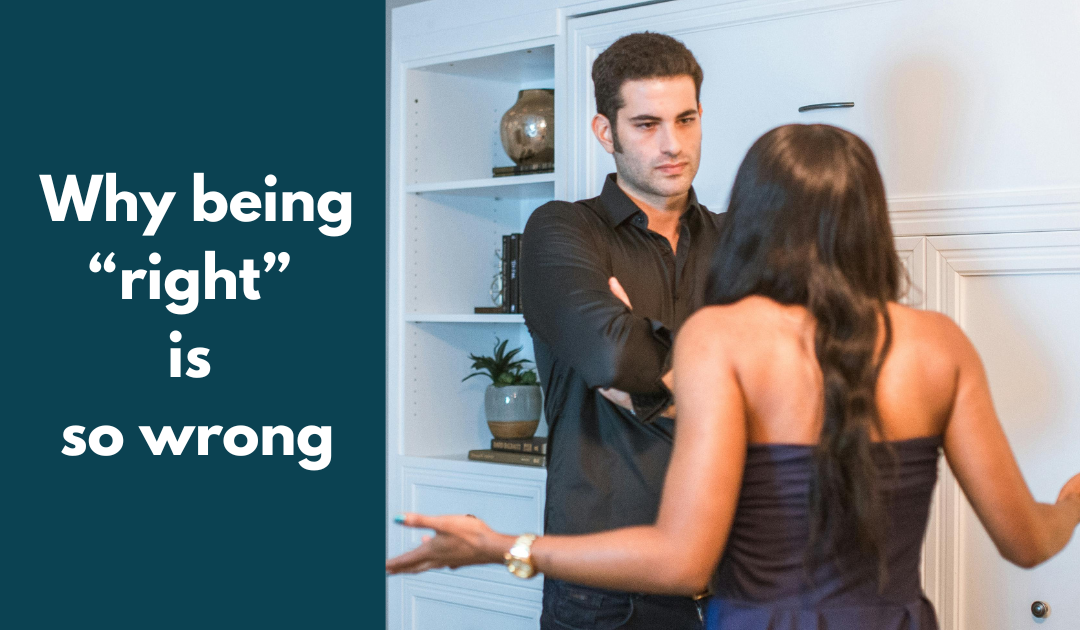
“Do you want to be right or happy? — Michael Easter
Most successful men are rewarded for finding problems.
At work, your ability to spot weaknesses is an asset. You identify risks before they become disasters. You challenge assumptions. You ask hard questions. You look for flaws in the plan before committing resources.
Your career may have been built on this skill.
Unfortunately, the same strength that makes you valuable at work can quietly damage your marriage.
Many men don’t realize they’re bringing this “professional” communication style home.
And their wives experience it as criticism.
The “Yes, But” Husband
Have you ever responded to your wife with something like:
“Yes, but that’s not the way it happened.”
“I understand, but you need to look at it differently.”
“That’s not what I meant.”
From your perspective, you’re adding clarity. From her perspective, you’re dismissing her.
Many men are taught from an early age that conversation is a way to test ideas, solve problems, and establish competence. You challenge one another. You debate. You play devil’s advocate. You look for holes in the argument.
In business, this can be incredibly useful. In marriage, it creates emotional distance.
Many of the men I work with are engineers, executives, attorneys, physicians, business owners, or analytical professionals.
Their minds are trained to identify errors. They correct inaccuracies. They solve problems.
And this mindset serves them extraordinarily well at work.
But your wife usually isn’t asking you to conduct a quality-control inspection of her feelings.
She’s asking you to understand her.
When your wife says:
“I feel like you’re never really present with me.”
Like Spock or Data, your brain hears:
“Statement factually inaccurate. Evidence exists to the contrary.”
And you respond:
“That’s not true. We had dinner Tuesday night. We spent all day Saturday together.”
You may have won the factual debate. But you lost the emotional conversation.
Most marriage conflicts are not disagreements about facts. They’re disagreements about experiences.
Your wife isn’t presenting evidence to a jury. She’s sharing her emotional reality.
When she says, “I feel alone”, she’s stating that she feels emotionally disconnected from you.
Too many men unintentionally turn these conversations into cross-examinations:
“When exactly did I do that?” or “Can you give me an example?”
While you may be trying to get more information, these responses often leave her feeling like she has to provide unequivocal proof. “
Over time, your wife begins to feel unsafe bringing concerns to you because she anticipates a debate instead of understanding.
Relationship researcher Dr. John Gottman discovered that healthy couples maintain roughly five positive interactions for every negative interaction during conflict.
Negative interactions include:
- Defensiveness
- Criticism
- Interrupting
- Invalidating
- Dismissing feelings
Positive interactions include:
- Showing interest
- Validating experiences
- Expressing appreciation
- Accepting influence
- Finding agreement
- Taking responsibility
Many husbands unknowingly reverse the ratio.
Every concern gets “corrected”.
Every complaint begets a defensive response.
Every conversation becomes a battle over who is right.
Eventually, your wife stops bringing issues to you altogether.
Many men interpret this silence as improvement.
It isn’t. It’s a red flag!
The goal of marital communication is not accuracy; it’s connection.
This doesn’t mean abandoning logic or agreeing with everything your wife says.
It means understanding that feelings and facts operate differently.
You can believe that you weren’t trying to hurt her, but she can still feel hurt.
Both things can be true.
You can think that all your hours at work is to provide a good life for her and your family and she can still feel lonely.
Again, both things can be true.
You also don’t have to surrender your perspective to understand hers.
Try This Instead
When your wife says something that feels unfair, inaccurate, or exaggerated, resist your urge to correct.
Instead, say, “Tell me more.” Ask “What am I missing” or “What do you need to make this better?”
These questions don’t require you to agree. They require you to become curious.
Curiosity creates connection.
Correction creates distance.
A Hero Husband understands that leadership at home is different than leadership at work.
At work, your value often comes from identifying problems. And being right earns you respect.
At home, your value often comes from creating emotional safety. And her feeling understand earns you trust.
Besides, your marriage doesn’t need a debate champion.
It needs a man who can set aside the need to be “right” long enough to truly understand the woman sitting across from him.
At the end of the day, very few men lose their marriages because they lacked intelligence.
Many lose them because they used their intelligence to defend themselves rather than connect with their wives.
You’ve got this. But if you don’t, I’ve got you. I will soon be offering an opportunity to develop better communication skills. If you’re interested, just reach out and type ME.
Responsibility, Not Blame for Your Marriage
"The single most empowering thing you can do is take responsibility for yourself, 100% of the time." Mel Robbins If you’ve ever had an argument with your wife and found yourself mentally building a case for why you were right, you’re not alone. You remember what she...

You’ve Changed But Your Wife Doesn’t Trust It
"Stop being afraid of what could go wrong, and start being excited about what could go right." Tony Robbins There’s a statistic every married man should know: Women initiate roughly 67% to 90% of divorces, depending on the study and the population being measured. The...

Own Your Part Without Taking All the Blame
"I will keep constant watch over myself and‚ most usefully‚ will put each day up for review." Seneca When things go wrong in your marriage, it’s easy to start building a case. You remember what she said. You remember what you said. You can probably point to the moment...